
Domestic passenger car sales grew by 2.89 per cent in March at 114,195 units as against 110,978 units in the same month a year ago.
Propelled by the top three automakers -- Maruti, Hyundai and Tata Motors -- domestic car sales surged by a robust 31.1 per cent in January.\n\n\n\n
The domestic car sales rose by 36.5 per cent in December as nine out of 11 carmakers recorded more demand due to lower prices after a budgetary cut in excise, cheap finance schemes and announcements of price hike in January.
Surging truck sales of Tata Motors, Ashok Leyland and Eicher Motors drove commercial sales up by 34.6 per cent during the first eight months of this fiscal.
Domestic passenger car sales grew by 23 per cent in December 2006 at 81,026 units as against 65,853 units in the same month a year ago.
Cheered by Maruti, Hyundai and Tata Motors, car sales surged by a robust 24 per cent in October 2003 as customers got attracted to low interest finance and a spate of car roll-outs.
Propelled by Maruti, Hyundai and Tata Motors, car sales surged by 12.8 per cent in September 2003 as customers reaped benefits of low interest loans and budgetary cut in excise.
The domestic car sales rose by a modest 6.7 per cent in August 2003 as market leader Maruti, Fiat and Hindustan Motors suffered a decline even as Hyundai and Tata Motors improved their performance.
Car sales zoomed nearly 38 per cent to 59,800 units in July when compared with 43,434 units sold in July 2002, according to data released by the Society of Indian Automobile Manufacturers on Thursday.\n\n
Car sales in the country surged by 41 per cent in May 2003 as all major companies like Maruti, Hyundai and Tata Engineering recorded strong growth following an eight per cent excise duty cut in this year's Budget.
Domestic passenger car sales jumped 28 per cent in April to 42,506 units from 33,195 units in the same month last year, the Society of Indian Automobile Manufacturers said on Wednesday.\n\n\n\n
Indian passenger car sales fell by 22.7 per cent in February to 37,446 units, down from 48,444 units in the same month last year, the Society of Indian Automobile Manufacturers said on Wednesday.\n\n\n\n
India's domestic passenger car sales rose 7.64 per cent in November, slowing after three months of double-digit growth as buyers postponed year-end purchases to the next year to boost resale values.
Passenger car sales rose 9.7 per cent in the domestic market in September to 77,411 units against 70,507 units in the same month last year.
Bucking a trend of two consecutive months of drop in sales, passenger cars sales in the domestic market witnessed a 14.8 per cent jump in August 2005 at 72,165 units against 62,845 units in August last year.
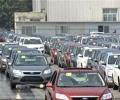
Sales of vehicles across categories registered a growth of 3.75 per cent to 16,19,689 units in January against 15,61,130 units in the same month of 2013
Healthy sales of passenger cars, motorcycles and commercial vehicles enabled Indian automobile industry to grow 15.9 per cent at 78,96,475 units in the domestic market in the fiscal ending March 31, 2005.
Car sales surged by 31.2 per cent in October 2004 for the seventh consecutive month this fiscal spurred by low interest rates and launch of a spate of new models.
The car sales went up by 9.88 per cent in the second month of this fiscal with Maruti and Tata Motors propelling the growth even as Hyundai slowed down the overall sales last month.
The domestic car sales surged by 41.3 per cent in November to 58,166 units from 41,146 units in the same month last year.

The local arm of the Japanese two-wheeler manufacturer accounts for every second scooter sold in India.
Domestic car sales rose by 15.2 per cent in March 2003 as the top three automakers, Maruti Udyog, Hyundai and Tata Engineering, reaped benefits.

Sales of commercial vehicles were up 5.63 per cent to 56,032 units in June, SIAM said.

Passenger vehicle exports from India increased 43 per cent in FY22, with Maruti Suzuki India leading the segment with dispatches of over 2.3 lakh units, as per the latest data by industry body SIAM. The total passenger vehicle (PV) exports stood at 5,77,875 units in 2021-22 fiscal, as compared to 4,04,397 units in 2020-21. Passenger car shipments saw 42 per cent growth at 3,74,986 units, while utility vehicle exports rose 46 per cent at 2,01,036 units during the last fiscal, the data by the Society of Indian Automobile Manufacturers (SIAM) showed.

Passenger vehicle wholesales in India rose significantly year-on-year in July, as COVID-led restrictions eased across states and companies pushed stocks to dealers to build up inventories for the upcoming festive season, SIAM said on Thursday. The total passenger vehicle sales -- including dispatches of cars, utility vehicles and vans -- from OEMs to dealerships increased by 45 per cent to 264,442 units in July against 182,779 units in the same month last year. According to the latest data by the Society of Indian Automobile Manufacturers (SIAM), two-wheeler dispatches from the OEMs to dealerships, however, declined by 2 per cent to 12,53,937 units in July, compared to 12,81,354 units in the year-ago period.

The company will also check the reorienting wiring harness related to the correct deployment of side airbags in the recalled vehicles.

Total sales of commercial vehicles were down by 5.59 per cent to 48,473 units from 51,344 units in the year-ago period, SIAM said.
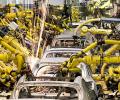
Indian automobile units are employing more and more robots to improve your car's efficiency. India is catching up well as world over, the latest technologies is redefining outdated manufacturing processes.

As part of the new Central Motor Vehicle Rules, the government is framing a mandatory recall policy entailing penalties.

Maruti Suzuki India Limited (MSIL), the country's largest car maker, has initiated a service campaign to inspect a probable fault and replace a part of the clutch operation system in the Ciaz, its mid-size sedan.

Domestic passenger vehicle sales dropped by 17.54 per cent to 2.25 lakh units in June from 2.73 lakh units in the same month of previous year, data released on Wednesday by an apex industry body showed.

Apart from around 40 Japanese companies and five global vendors of MG Motor India, many other biggies are eyeing Gujarat for either greenfield opportunities or brownfield expansion.

Maruti Suzuki India (MSIL) - the market leader in small cars - is eyeing the top spot in the sports utility vehicle (SUV) segment within a year - with a 33 per cent share of the pie. The company has been selling two SUVs - the Brezza and the Grand Vitara - and will start deliveries of the Jimny and the Fronx from March-end, and has set a target of growing its share from the current 11.5 per cent of the SUV market to 33 per cent by the end of 2023-24. The SUV segment is roughly about 42 per cent of the total passenger vehicle market, or around 1.3 million units.

As India is progressing towards Bharat Stage IV (BSIV) emission norms, most cars still run under BSIII standard.

An average of 30-40 per cent automation is standard across all big automobile plants in the country
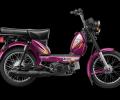
TVS Motor Company, the only company in India to manufacture mopeds, said domestic sales dropped by 25.58% in April-Oct and exports fell by nearly 40%.

'He was a practical person who ensured that he thought about the common man, animals, the fact that they have a life and they have to be respected.'

Companies in the micro, small and medium enterprises (MSME) sector may legally challenge the Haryana government's new law which mandates 75 per cent reservation of jobs in the private sector for locals. "We had earlier gone to the high court against this law, but the court said that it would hear the matter after the law was notified," said Manoj Tyagi, general secretary, IMT Industrial Association. Industries and associations feel that the law will not benefit the state and will hit MSMEs that are just coming out of the crippling effects of the lockdowns owing to the Covid-19 pandemic.
 © 2026 Rediff.com - Advertise with us - Disclaimer - Privacy Policy - Sitemap - Feedback - About us - Terms of use - Grievances